One extra bond.
23 broken molecular jobs. 73 collapsed cellular checkpoints.
A threonine where an alanine should be. It grabs Cys554, stiffens a hinge built to stay flexible, and locks the molecular machinery that powers the enzyme.
SAMHD1 is not one job. It manages DNA building blocks, repairs broken chromosomes, restricts viruses, calms inflammation, and protects mitochondria — working across 73 checkpoints in every compartment of the cell. Damage the enzyme and you do not get one disease. You get a family that has been misdiagnosed one organ system at a time for a hundred years.

It was never only an immune problem.
SAMHD1 only works as a tetramer — four copies assembled together. One variant copy does not give you half an enzyme; it gives you tetramers of mixed composition. Anything that needs all four subunits intact falls much further than gene dosage predicts. That split is why the damage lands across five separate domains of biology at once.
dNTP balance
Cell metabolism. The dNTPase and everything that runs on it — the hardest hit.
9 functions · >75% lossGenome integrity
Fork stabilisation and homologous recombination. Tumour-development risk.
16 functions · 30–40% lossViral restriction
Intrinsic immunity — HIV-1 and mobile elements. Runs on the dNTPase.
5 functions · >75% lossImmune modulation
The IRF7 brake and the interferon second wave. Autoimmunity.
15 functions · 30–40% lossMitochondrial integrity
VDAC1, mtDNA containment, mitophagy. Where the metabolic arm and the immune arm turn out to be the same arm.
9 functions · catastrophicKept deliberately off that scale: the cancer associations, which are lifetime probabilistic risk rather than a per-cell deficit — including renal clear cell carcinoma, the one place where having less SAMHD1 helps. An atlas that showed only harms would be an advocacy document rather than a model.
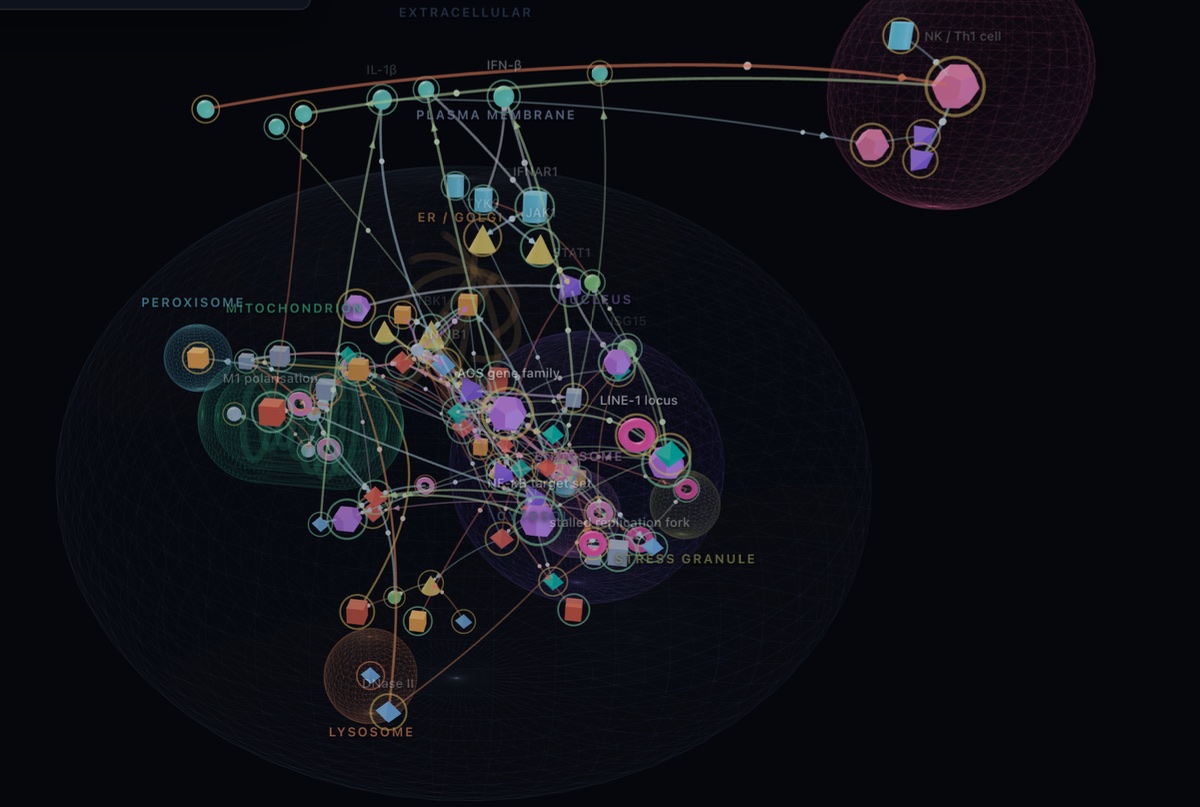
The Immune Atlas
Fly inside the cell. Isolate one pathway. Ask for every route from the variant to type-I interferon and it enumerates 379 of them, then walks you along one reaction at a time — each with its mechanism, its citation and its evidence grade. Compare wild type against ten predicted study arms.
Open atlas →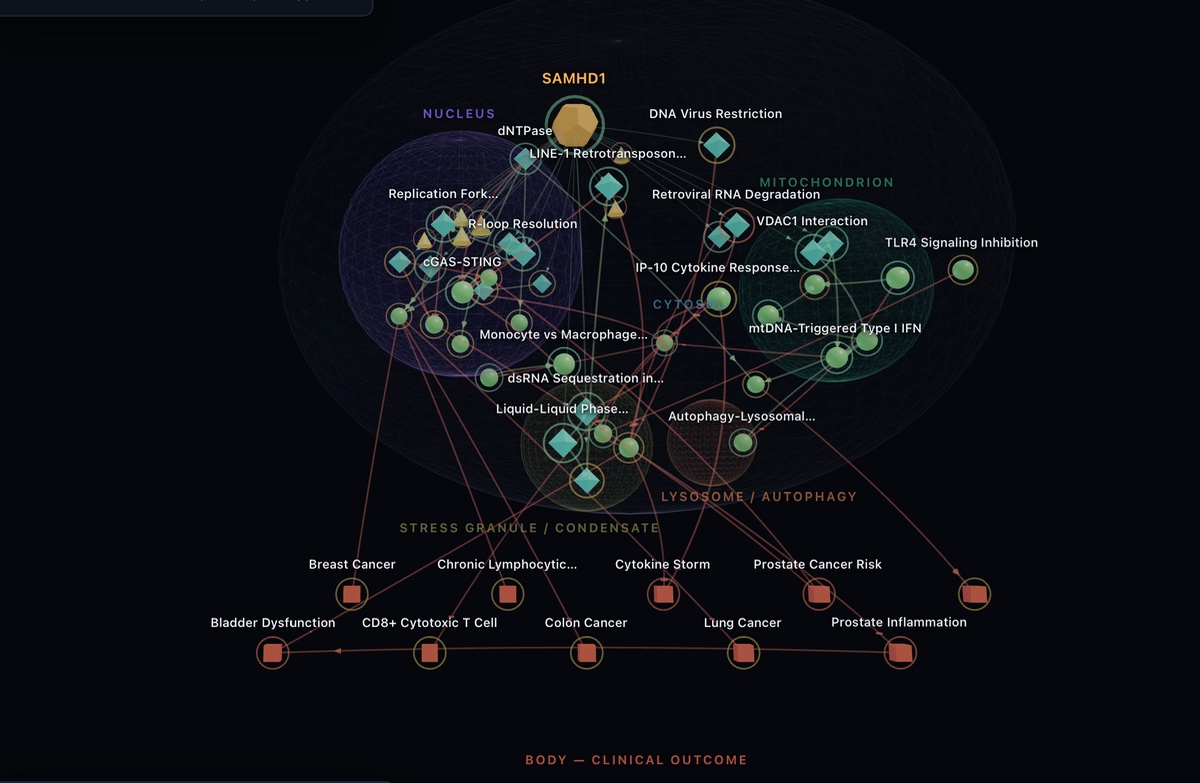
The Function Atlas
Every function SAMHD1 has, placed in the compartment where it happens — sorted into four tiers so that distance on screen is distance in the argument. One switch dims the whole board to what a single working copy can still do.
Open atlas →Every question on this site opens as a live view.
Both atlases address every state, every route and every evidence filter. So a question here is not a link to an article — it is a link into the model, already set to the answer, with the citations attached. A few hundred bytes you can send a colleague instead of a screen recording.
Every way A565T induces type-I interferon
The question the whole framework turns on. 379 routes, enumerated within sixteen steps.
/atlas/#all →Why half a gene is not half a function
The tetramer, and the shape of the damage it makes.
/function-atlas/#tour=tetramer&step=1 →What a JAK inhibitor actually fixes — and what it misses
Loop B, step 5: the therapeutic gap, rendered as the board under treatment.
/atlas/#tour=loop-b&step=5 →Where the evidence is thin
Filter to demonstrated-only and watch most of the picture disappear. What is left is what can be argued from.
/atlas/#ev=S →A hundred years of misdiagnosis, in one family.
Post-viral fatigue in one generation. Inflammatory arthritis in another. Metabolic disease at normal body weight. Connective-tissue failure. Pre-eclampsia and early delivery, recurring. Five generations of specialists, each treating one organ correctly and none of them holding the whole picture.
Sequencing found the same single-copy variant running from an infant to a relative in advanced old age — including one confirmed carrier who is clinically unaffected, which makes this family its own control group.
Advanced old age
ME/CFS, decades ago
Includes the unaffected carrier
Index generation
An infant
No names, ages, dates, photographs or identifying details appear on this site. The kindred is described only by generation and de-identified phenotype; clinical records are held privately and never published.
- Publish the phenotype. No case report of the heterozygous state exists. Until one does, no clinician can recognise it.
- Confirm the mechanism. ISG scores across the kindred, primary-cell work, and the structural question at the C-terminal latch.
- Treat what is treatable now. JAK inhibition clears the interferon arm and leaves a JAK-resistant floor. Six study arms are designed around that split.
- Open a path to correction. One base change. The weekly sweep tracks prime editing, base editing and delivery alongside the biology.
Looking for a cohort? We are one, already assembled.
Five generations, three sequence-confirmed, with an internal control carrier. Consent, records and scheduling are coordinated by one family member acting as cohort manager, so you correspond with a single inbox rather than five households. Six-arm study proposal and mechanism concept note available on request.
An automated semantic sweep of the literature, scored against this exact phenotype, published every week.